


🌹 Why is Rose Celebrated as the “Queen of Flowers”?
- Eva Zhan
- Jan 27
- 4 min read

1. The Story behind Rose Flower Extract
In ancient Chinese folklore, a celestial Flower Goddess cultivated a mysterious rose garden in the heavens. One day, a mortal scholar suffering from melancholy and depression stumbled upon this divine garden. Out of compassion, the goddess offered him rose petals and instructed him to brew them into tea. Upon drinking, his sorrow dissipated, his energy flowed freely, and his complexion brightened. This tale resonates with the wisdom in Compendium of Materia Medica by Li Shizhen, which recorded rose’s abilities to “soothe the liver, relieve stagnation, invigorate the blood, and ease pain.”
For centuries, roses have been revered not only as a symbol of love but also as a powerful herb for harmonizing emotions and vital energy. With over two thousand years of medicinal and ornamental use, rose petals and essential oils were recorded in the pharmacopeias of Persia, Egypt, and China for calming the spirit, regulating Qi, and enhancing beauty. In European herbal traditions, rose teas and tinctures were frequently used for digestive health and cardiovascular support. Today, roses are celebrated worldwide for their mood-balancing, antioxidant, and skin-nourishing properties.
2. The Botanical Characteristics of Rose Flower
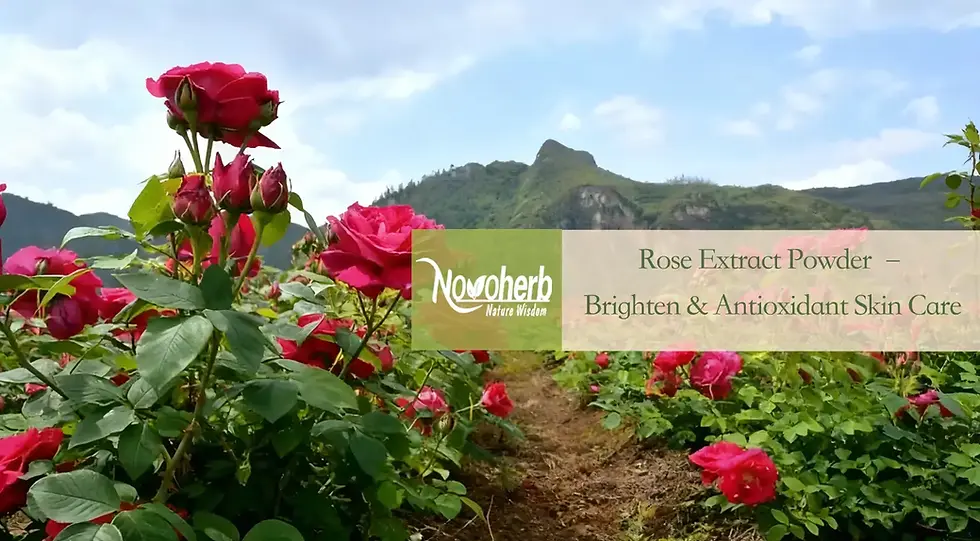
Roses belong to the family Rosaceae, comprising over 300 species and thousands of cultivars. Adaptable and fragrant, their prized flower buds are harvested just before blooming and carefully dried to preserve their aromatic oils and bioactive compounds. Widely cultivated in temperate climates, roses present a diverse range of colors—pink, red, white, and yellow.
Item | Description |
Chinese Name | 玫瑰花 |
English Name | Rose Flower |
Latin Name | Rosa rugosa Thunb. (commonly used medicinal species) |
Family / Genus | Rosaceae / Rosa |
Morphology | Multi-petaled aromatic flower, colors range from pink, red, white to yellow |
Medicinal Part | Petals, buds |
Habitat | Prefers temperate climates, widely cultivated in Asia and Europe |
Harvest Season | Spring to early summer (April–June) |
Pharmacopeia | Chinese Pharmacopoeia (2020 edition) |
Main Origins | Yunnan, Gansu, Shandong (China); Bulgaria, Turkey, Iran |
3. Active Constituents Inside Rose Flower Extract
The pharmacological benefits of rose derive primarily from its essential oils, polyphenols, and flavonoids.
Category | Source | Function |
Flavonoids (Quercetin, Kaempferol) | Petals | Antioxidant, anti-inflammatory |
Phenolic Acids (Gallic acid, Ellagic acid) | Petals | Antimicrobial, cardioprotective |
Essential Oils (Citronellol, Geraniol, Nerol) | Petals | Aromatherapy, calming |
Anthocyanins | Petals | Antioxidant, vascular protection |
Tannins | Petals | Astringent, digestive support |
Polysaccharides | Petals | Immune modulation |
Vitamins (C, E) | Petals | Skin health, collagen synthesis |
Minerals (Ca, Mg, Zn) | Petals | Enzyme and metabolic support |
Organic Acids (Malic, Citric acid) | Petals | Detoxification, digestive aid |
Proteins & Amino Acids | Petals | Nutritional support |
4. Health Benefits of Rose Flower Extract in TCM
In Traditional Chinese Medicine, roses are classified as herbs that regulate Qi, resolve stagnation, harmonize blood, and relieve pain—closely associated with the liver and spleen meridians.
Function | TCM Description | Classical / Common Combinations |
Regulate Qi & Relieve Stagnation | For liver Qi stagnation with chest oppression, mood swings, or irregular menstruation | Bupleurum, Cyperus, Tangerine Peel |
Harmonize Liver & Spleen | Relieves stress-induced digestive discomfort and poor appetite | White Peony, Atractylodes, Poria |
Invigorate Blood & Regulate Menses | Used for dysmenorrhea and blood stasis | Angelica Sinensis, Chuanxiong, Red Peony |
Calm the Mind & Relieve Depression | Eases irritability and promotes emotional well-being | Albizia Flower, Polygala, Suan Zao Ren |
Promote Beauty & Skin Health | Nourishes complexion and supports women’s beauty | Goji Berry, Tremella, Pearl Powder |
Harmonize Teas & Tonics | Enhances taste and aroma in floral teas and functional foods | Chrysanthemum, Jasmine, Wolfberry |
5. Unlock the Power of Rose Flower Extract by Science
Modern pharmacology validates rose’s traditional uses:
Antioxidant: Rich flavonoids exhibit strong free-radical scavenging activity, protecting skin cells and slowing aging (Food Chemistry, 2024).
Anti-inflammatory & Antimicrobial: Rose essential oil reduces skin inflammation and inhibits pathogens (Phytotherapy Research, 2022).
Mood Enhancement: Rose volatiles lower cortisol levels and activate parasympathetic activity (Journal of Alternative & Complementary Medicine, 2023).
Skin Care: Rose extracts provide hydration, anti-wrinkle, and brightening benefits.
Women’s Health: Rose tea supports menstrual comfort and cycle regulation.
6. The Mechanism of Action of Rose Flower Extract
Rose’s bioactivity involves synergistic pathways:
Recognition: Flavonoids and polyphenols neutralize free radicals.
Signal Pathways: Regulate NF-κB and MAPK, reducing inflammation.
Systemic Effects: Enhance mood, balance hormones, and strengthen skin barrier function.
7. Global Applications of Rose Flower Extract
Cosmetics: Perfumes, skin creams, anti-aging products
Food & Beverages: Rose teas, desserts, syrups, jams, candies
Traditional Medicine: Formulas for women’s health and digestion
Aromatherapy & SPA: Essential oils for stress relief and sleep support
Pharmaceutical Research: Studied for cardiovascular and neuroprotective effects
Nutraceuticals: Used in antioxidant and anti-aging supplements
8. Market Trends of Rose Flower Extract
According to Grand View Research (2024):
Market Size: Global rose extract market projected to exceed USD 620 million by 2030, CAGR 7.8%.
Growth Drivers: Rising demand in cosmetics and functional foods for natural mood support, “skin–gut–mind axis” solutions, and clean-label botanicals.
Key Markets: Asia-Pacific (China, India), Europe (Bulgaria, Turkey), Middle East.
Innovation Trends: Rose-collagen beverages, probiotic-infused rose skincare.
Technological Advances: Enfleurage and supercritical CO₂ extraction enhance essential oil yield and quality.
9. NovoHerb Rose Flower Extract for Your Health and Business
From mythical heavenly gardens to modern wellness formulas, rose continues to symbolize beauty and emotional harmony. NovoHerb selects premium roses, ensuring optimal levels of active constituents, delivering the combined values of beauty, health, and emotional balance.
For Consumers: Rose offers a gentle, elegant, and effective way to relax the mind, ease emotional tension, support natural beauty from within, and promote overall vitality. It transforms daily rituals into moments of self-care and balance.
For Businesses: Rose is a beloved and versatile ingredient with strong scientific and traditional foundations. Its applications span mood health, women’s wellness, and natural skincare—fast-growing markets. Incorporating high-quality rose extract empowers brands to create products that deeply resonate with consumers seeking holistic, sensorial, and evidence-based wellness solutions.
Comments